Euclidean and Babylonian Thinking
2026.09.051,136 Words
Feynman has a lecture on the difference between Euclidean mathematics and Babylonian mathematics. Euclidean focuses on establishing axioms or first principles to reach conclusions, using these axioms as tools of deduction. Babylonian focuses on finding independent facts where something holds to be true then leveraging those instances to reach conclusions. Tech companies are too focused on the former when the latter can be just as effective.
Euclidean
The core issue with “first principles” in tech is the question “What principle is first?”. I’ve been in plenty of calls where someone states “let’s think from first principles” while the room gets quiet. This is solely to the advantage of the speaker. No one challenges them once they’ve posited their principles. We do this because one, it is probably your boss who mentioned first principles, and we can’t look unaligned, but two, they often turn into an infinite regress, an hour spent just discussing what the first principles may be. No action items or next steps will be documented except for another call where the first principles will be debated. Everyone involved will become annoyed quickly. First principles in practice isn’t a truth seeking mechanism but a hammer.
First principles also fails in its assumption of objectivity. One has to assume these business or product contexts are simple formulas, of which, they are not. Our bounded rationality doesn’t allow us to account for the myriad of variables it would take to establish objective first principles. We can’t map out each sequential scenario with each node in the network or its relation to the overall system in a timely manner, leading to satisficing in our decision making. A derivation of what we can map in a given moment. This satisficing leads to bias. This bias may lead to a shaky foundation. However, our shaky foundation isn’t only because our axioms are biased but because first principles suffers from a multiplicative effect. See the below diagram.
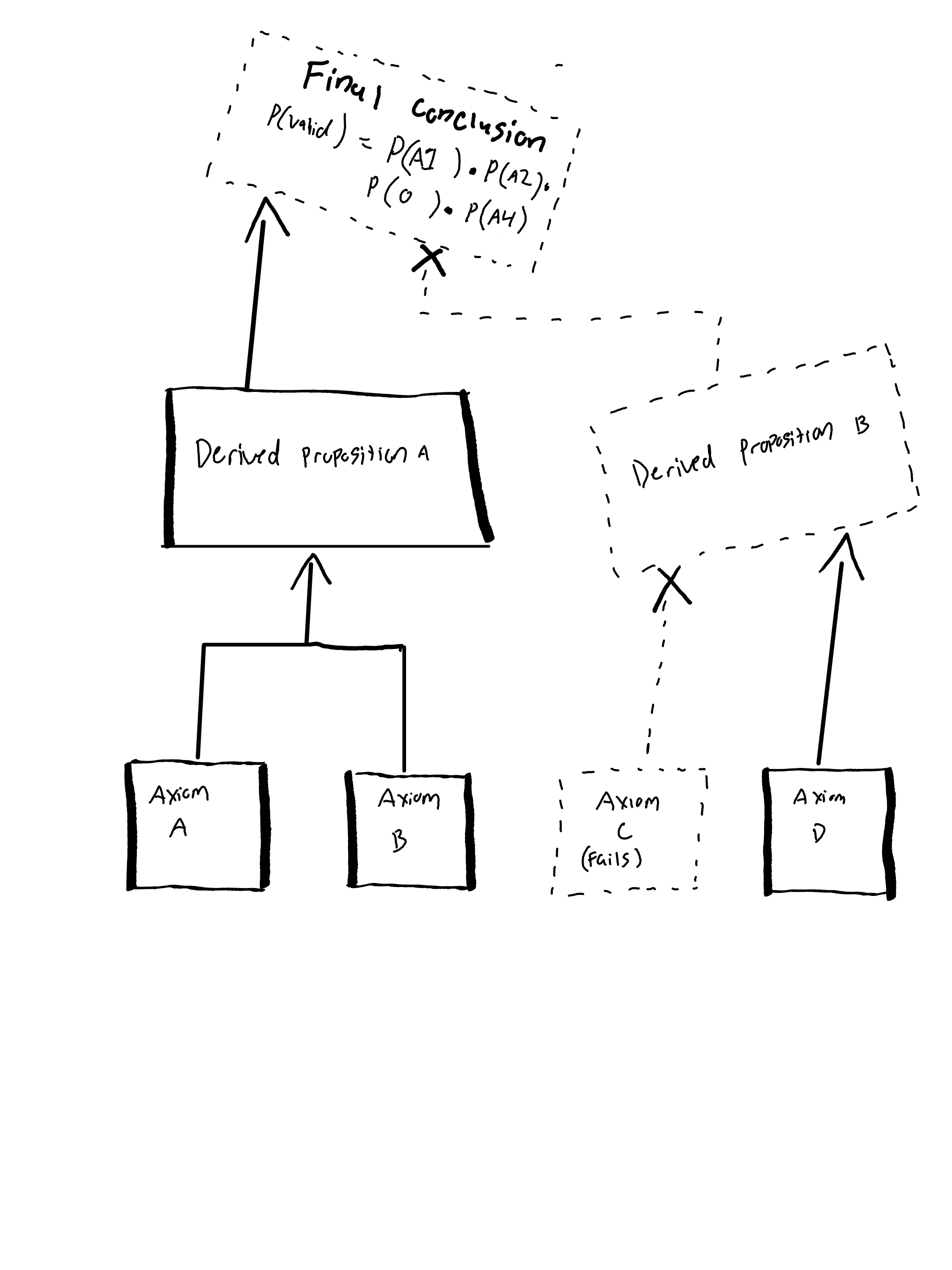
First principles define a few axioms which are derived to reach a conclusion in a hierarchical manner. These axioms are functionally a serialized chain. Each axiom must be true to reach a final conclusion about the world. The problem is when one of these axioms fail, the whole structure of the conclusion is at risk. Each axiom assumes the other is true. If one is falsified, and due to the limited nature of axioms people define, you have broken a core pillar of your truth. Is your conclusion a 4 legged chair or a 2 legged chair? Will it wobble? Collapse? Complete reassessment of your axioms will be required which likely results in a pivot.
These two issues loom large over Euclidean thinking.
Babylonian
This reveals an interesting property of first principles. For what you gain in clarity of thinking from your first principles, an admirable endeavor, you lose the ability to adapt as errors inevitably arise. How might we embrace errors in our method? According to Feynman, we should utilize a Babylonian mathematics approach. Instead of using a few axioms which we use to derive a conclusion, we map a large series of independent cases, across modalities, to build a worldview based on partial truths. In effect, a flat network.
The Babylonian develops robustness through a network of independent cases. This network of cases benefits from flexibility compared to first principles. Instead of a multiplicative effect, if a node or fact fails, we are able to “turn it off” from our model in the world. But that conclusion will still be supported by a vast series of other cases which are connected. One node failure doesn’t result in system failure if the conclusion has significant enough edges with other nodes. The conclusion becomes more robust to change over its lifecycle as it forms to new arising information in the world.
The second benefit is we are more likely to reach the most fundamental principles based on this network.
Let’s try to determine the shape of the earth. We have a litany of facts spanning history, across cultures, to reach the conclusion that it is probably a sphere. It started with Pythagoras making an aesthetic claim of the Earth’s roundness that “the sphere is the most beautiful of solid figures” but later bolstered by Aristotle with his proofs around the lunar eclipse. We later get Magellan circumnavigating the globe, providing a physical fact to back the conclusion. We are obviously now at the point where space photography can provide pictures of the earth, let alone the astronauts who validated the claim with their own eyes. We have mathematical, visual, photographic and kinetic facts to believe the earth is round.
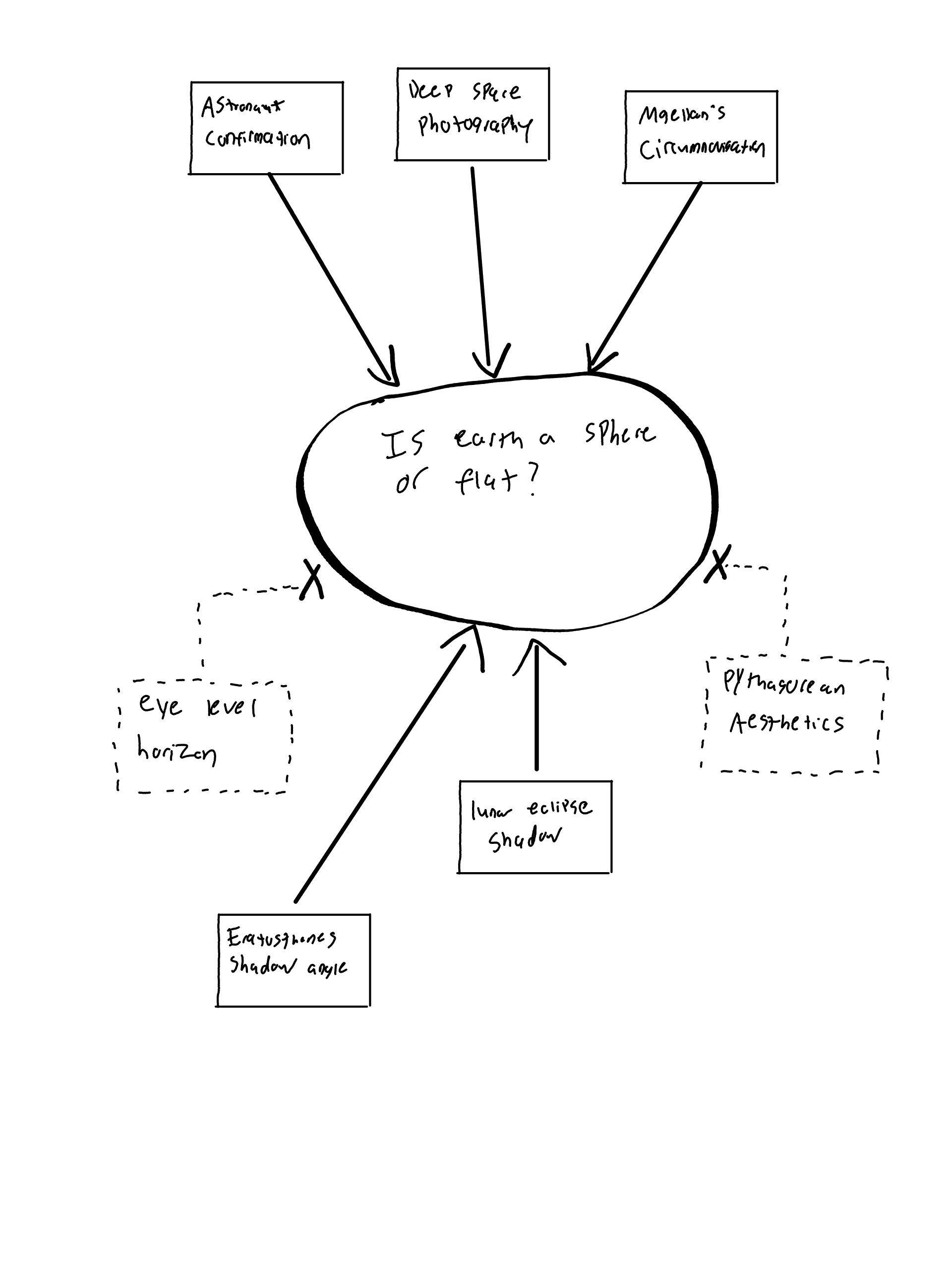
Although we have all these facts, some also failed throughout history! The obvious failure is of our eyes. We are unable to identify Earth’s curvature on the horizon overseeing an ocean or from the mountaintop, potentially leading us to believe that our current plane must always be flat. We also need to throw away the Pythagora’s aesthetic claim that, although correct, isn’t due to the inherent perfection of a sphere. The core idea remains robust even with some of these nodes failing in the process as we have a series of partial truths.
The core conclusion is continually amplified across varied independent modalities. The more edges something has, the more robust or unlikely to change the thing is. To prove a conclusion in a multitude of ways gets us to the most fundamental principles because the most fundamental things must have a large series of edges in the graph.
This flat ontology allows us to not only identify the fundamental laws more easily, but also allow us to embrace the inevitability of localized errors.
Conclusion
"If we begin with certainties, we shall end in doubts; but if we begin with doubts, and are patient in them, we shall end in certainties."
Babylonian thinking embraces errors rather than papering over them to give people certainty. We must sit with our list of partial truths, as anxious as it is, and continue pruning them until we reach some clustered truth. This is more uncomfortable than first principles but provides an openness to the world that axioms cannot. This clustered truth is still context specific however. We aren’t able to draw up perfect principles that extrapolate across every perspective. Given how localized our issues become, principles, while nice, are cozy guiding stars, a single point of failure to orient us within the world. And what happens when the sun rises? You can wait until another star appears, or, find a few landmarks.