How to Read More
2024.12.231,817 Words
Reading more books compounds your life in unexpected ways, akin to the serendipity machine that is Twitter. Books slowly shift your internal perception to the point where the external world is affected by your derivative outcomes. This steady change means that any benefit of reading appears negligible in the moment and significant in hindsight. Assuming you plan to live a long life, these are the things that helped me build a strong reading habit:
- Consistent scheduling
- Maintaining a book rotation
- Dropping and picking up more books
Set a Consistent Time, Built Slowly
First things must come first: You have to develop your reading practice. You won't be able to take advantage of the remaining ideas if you can't commit to reading. However, it's impractical to begin by reading an hour per day, something few people can force themselves to do.
Start by building a stupidly small habit, one you wouldn't dare to tell your friends, let alone strangers on the internet. A good start is less than 5 minutes a day. Surely no one would adopt the identity of a reader with less than 5 minutes of reading a day? But that is how you need to start.
Reframing this as a question, can you stop scrolling [insert social media] for 5 minutes per day to read? The answer is always yes.
Assuming you are at week 0, your goal is to hit that 5-minute mark each day. If you complete your goal each week, increase the time commitment for reading by a few minutes. Incrementing your time by comically small amounts is one of the keys here. If you start reading 5 minutes daily in week 0, don't hop-skip to 10 minutes in week 1. Hop to 7 or 8. Week 2, complete the skip to 10 minutes.
Our minds quickly and subconsciously weigh raw time commitment and marginal addition of minutes. We trick our brains into focusing on the two minutes by beginning with undersized increments. Although this is almost a 50% increase in time, the absolute time, two minutes, is nothing compared to the number of minutes in a day.
However, if you double the reading time from 5 to 10 minutes, your brain immediately notices the doubling effect. This doubled time creates a new barrier, making habit formation more difficult. This reveals that the marginal addition of minutes is essential both in percentage and nominal terms. Adding small increases in nominal and percentage terms bypasses your brain's alert system, making the habit stickier.
It'll feel slow, adding only a few minutes each week. You will feel stupid. You will think that 16 minutes a day isn't an accomplishment. You will have to fight and remember, compared to reading 0 minutes a day, yes, it is an accomplishment. The energy you spend reading for 5 minutes will eventually become a ritual, and you won't think anything different from 45 minutes. Reading begets reading.
Sample Bad Schedule
| Week Number | Total Time Reading | Minute Increment | % Increment |
|---|---|---|---|
| Week 1 | 5 Minutes | — | — |
| Week 2 | 10 Minutes | 5 Additional Minutes | 100% |
| Week 3 | 20 Minutes | 10 Additional Minutes | 100% |
| Week 4 | 45 Minutes | 25 Additional Minutes | 125% |
| Week 5 | 60 Minutes | 15 Additional Minutes | 66% |
Sample Good Schedule
| Week Number | Total Time Reading | Minute Increment | % Increment |
|---|---|---|---|
| Week 1 | 5 Minutes | — | — |
| Week 2 | 7 Minutes | 2 Additional Minutes | 40% |
| Week 3 | 10 Minutes | 3 Additional Minutes | 42% |
| Week 4 | 13 Minutes | 3 Additional Minutes | 30% |
| Week 5 | 16 Minutes | 3 Additional Minutes | 23% |
Maintaining a Book Rotation
"If, for example, we consider books as medicine, we understand that it is good to have many at home rather than a few: when you want to feel better, then you go to the 'medicine closet' and choose a book. Not a random one, but the right book for that moment. That's why you should always have a nutrition choice!"
Now that you have a schedule, you have a new problem; some books will bore you. Like life, some book you want to read will feel like a slog or you want a different type of story that day. To combat this, a rotation of books caters to our shifting moods while maintaining the reading habit we want to keep. It gives us control over our reading experience, allowing us to switch to a different book when we feel like it. Having 2 - 4 books in rotation, split by various difficulties and genres, keeps things fresh.
Book Difficulty
A quality rotation should be spread over different difficulty rankings [insert your difficulty rankings here]. My personal scale is simple:
- Easy
- Medium
- Hard
Assessing a book's difficulty is vibes-based and personal to the reader. A book that may be easy for you might be hard for another person. But the cool thing is that since the difficulty is subjective, it varies over time as we fuse our past and present. By reading more books, you can reduce later "Hard" books to "Medium" or even "Easy." Like most other fields, reading has intense compounding effects, resulting in a graph that looks like this.
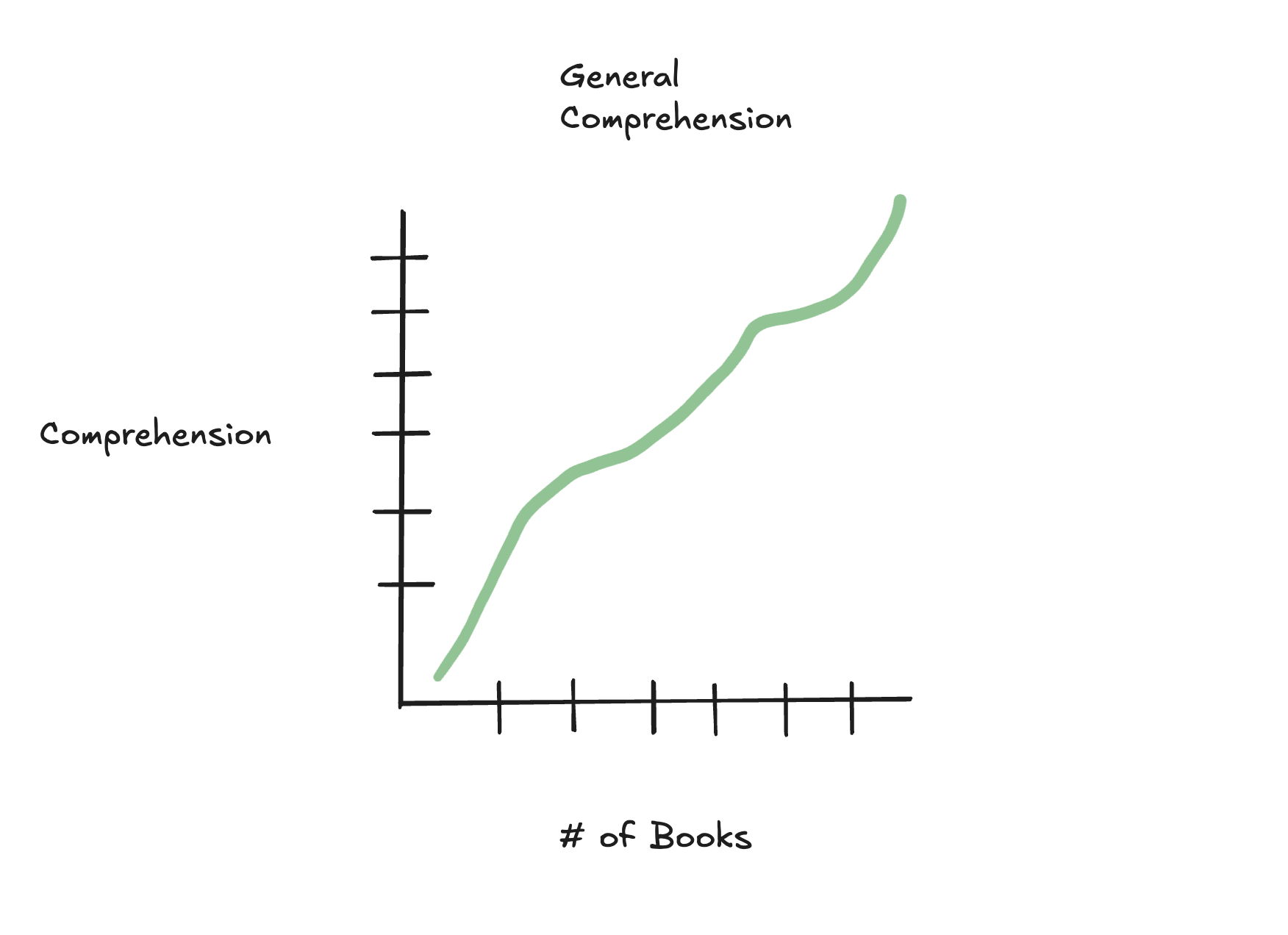
For a personal example, War and Peace is widely considered "Hard" for people due to its length, historical context, and dated prose. However, I wouldn't classify it as a "Hard" read on my scale. Why? I've read most of Tolstoy's work, multiple books on Russian history, and other novels by prominent Russian authors of the time. I have already integrated the historical context and familiarity with the prose through my network of prior reads. Therefore, War and Peace is a question of length and themes, classifying it as a "Medium" book.
On top of general comprehension from reading many books, I have built a domain of expertise in this niche topic (18th and 19th century Russia). When extrapolated outward, your experience becomes more like the following chart, with knowledge functioning as the inverse of difficulty.
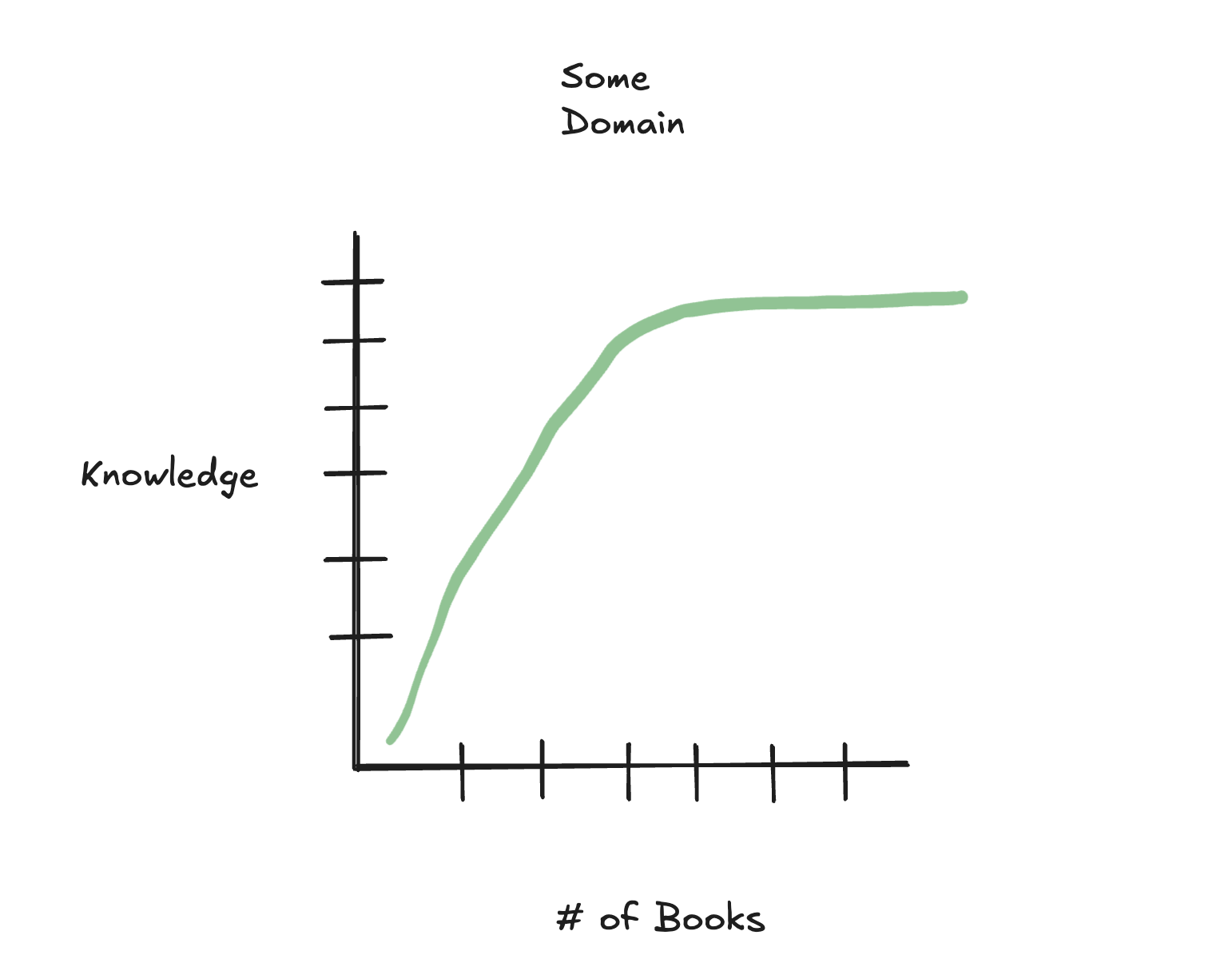
Shockingly, reading books in adjacent domains makes other books in your domain easier. You stack context by reading a particular niche, making further forays into the field less difficult. Possibly reducing a "Hard" book down to "Medium ." Tyler Cowen reads multiple books in successive order to develop this domain knowledge fast and consistently.
Book Diversity
Another essential aspect of a quality book rotation is maintaining a wide range of book genres. Sitting high from your lonely mountain yelling, "I only read nonfiction," isn't a sign of intelligence; it's a sign of narrowness. Reading a mix of fiction, nonfiction, essays, textbooks, and poems all add to the continuous integration of knowledge.
There will be trends in your reading preferences across time, and some will underpin your whole life, like the nonfiction-only person. It isn't a sin to embrace this. As an example, I have read 20+ Russian novels. This lives outside rationality, except for the rationale that I love reading them. Simultaneously, I read plenty of other books on software engineering, financial history, and literature. Building balance takes intentionality but is well worth it.
Music is the space between the notes
Example of a book rotation of mine earlier in the year:
| Name | Author | Difficulty | Genre |
|---|---|---|---|
| Three Summers | Margarita Liberaki | Easy | Fiction |
| The Design of Everyday Things | Donald Norman | Medium | Non Fiction |
| Technology and the Lifeworld | Don Ihde | Hard | Non Fiction |
Dropping and Picking up Books
Lastly, embrace picking up and dropping books often. Finishing or continuing books you don't enjoy is a slight against the soul. Your time is precious, and spending time on a book you hate, assuming you gave it a real shot, wastes your time.
There is an implicit shame in not finishing a book, a sign of weakness enforced by GoodReads culture and the commodity fetish of BookTok. You aren't weak or uncommitted for not finishing a book. It simply wasn't worth it at that point in time.
You don't even need a good reason to drop a book. It can be as simple as "I don't like this" or as complex as "I am not sure if I am ready for this book in my life ."Both reasons are entirely legitimate if you feel they are right. Finishing books is a statistic that we use to track on GoodReads and becomes an optimization problem that we can’t run away from. The only person that is owed a reason to drop the book is you.
But in that same vein, the concept of picking up the book in the first place needs to be challenged. The entire concept of all books requiring consistent reading needs adjusted, allowing for more books just to be picked up and read periodically. We used to call these “Coffee Table” books but I contend all books fall in this category.
An example is a book of short stories, a textbook on something you have a lot of interest in. We used to call these "coffee table books" but I argue most books should be considered coffee table books. Any book your put in this category should be left whever there is an open seat or a comfortable looking parcel of flooring. By picking up books randomly and not fully committing to them, reading becomes a default activity, not something of energy expense.
Examples of books I’ve dropped and pickup sometimes:
| Name | Author |
|---|---|
| Solenoid | Mircea Cartarescu |
| The Golden Thread | Kassia St. Clair |
| Lord and Peasant in Russia” From the Ninth to the nineteenth Century | Jerome Blum |
| Name | Author |
|---|---|
| The Marriage of Cadmus and Harmony | Roberto Calasso |
| The Secret Lives of Color | Kassia St. Clair |
| A History of Western Philosophy | Bertrand Russel |