The Median Interface
2026.09.171,137 Words
Hotelling Overview
Hotelling’s law tells us competitors in a given market tend to cluster around a similar set of products or features to capture the largest share of the customer base. A common example outside of business is when politicians cater to their base in primaries yet become more centrist when they enter popular general elections. As the reward for centering rises, so will players in a game take advantage of this fact. This also manifests in the agglomeration of chains, such as CVS and Walgreens being close together.
Harold Hotelling originally made this observation in 1929 with two identical ice cream stands. Let’s assume we have a linear beach. If each ice cream stand started at opposite ends of the beach, we’ll see they can’t fully cater to all customers. They will only walk the shortest distance to get the sweet treat. What is the ice cream salesperson to do?
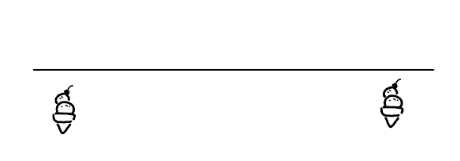
They certainly won’t let luck determine their business future. They don’t want to differentiate or cut prices yet so they move to the middle to capture more customers. However, the second salesperson, noticing a dip in sales, does the same thing. We now have 2 ice cream shops at the median of the beach. What pressures now face them since they are next to each other?
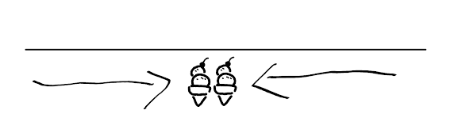
The most obvious is pricing pressure. These identical ice cream stands main tool for customer acquisition is to offer lower pricing on their cones. However, both will continue lower pricing until they reach a margin barely above their cost-of-goods-sold, not leaving much for ongoing costs or larger revenues. Another option is to differentiate the offering. Maybe you add gelato or FroYo. Or you offer a luxury ice cream with higher margins. It may work, but it is a bet! Maybe customers enjoy it, temporarily gaining you margin, but why then won’t it be copied? Moats aren’t as deep as we think they are.
But it is also important to consider that products do not live on a linear beach. The world is multi-dimensional which allows for a variety of strategies and tactics to be tested as cited in the 1979 paper by d’Aspremont. Even if pricing is is one dimensional, there are a variety of other ways for our ice cream stand to differentiate itself from its competitors.
UI Components
Hotelling is directly applicable to the changing landscape of UI. Any AI tool today can recreate a component or micro-animation in minutes with high accuracy. UI components effectively become input <> output, cheapening them to a degree that we haven’t seen since the Bootstrapification of the 2010s. What happens to software companies in a world where UI is cheap?
This reduced cycle time seems to be an advantage to new, disruptive startups to attack their incumbents. The opposite is actually true. The innovating startups that commit to a cleaner experience will have their UI components copied by large incumbents. Any innovative patterns, components or flows will get adopted faster than they would have otherwise because 1) AB testing frameworks are incredibly advanced 2) copying UI will become cheap 3) incumbents will have the budget, driven by profit, to sustainably cherrypick the best patterns from competitors. At the same time, other excessively funded startups will copy patterns quickly too. All of these companies will converge on a median and feature set for a specific product vertical. Sounds like our ice cream stands.
How does a company compete if UI isn’t a differentiator? To Benjamin Graham’s delight, we have to return to business fundamentals. Companies with large distribution channels or lindy brands will continue to engrain themselves in the core architecture of our software systems. Disruption from upstarts within a product vertical will be less likely while disruption from different levels of the value chain (i.e. AI agents) will cause more headaches. At the same time, Hotelling will come for these large businesses competing for the same market as well.
Remember, these gorillas will coalesce around similar UIs or features, cheapening their offering by catering to the largest base of users. Both Salesforce and 365 Dynamic will be in a war to win customers ceteris paribus. But the war will never end given how much easier it will be to transport data between these systems with AI. Customers will win overall in this market. But small competitors will struggle to compete on the same dimensions. As the old Consulting-ism goes, “No one gets fired hiring Big 4”. The same logic will apply to these core B2B systems.
How UI evolves?
So UI is dead? It becomes a commodity good that doesn’t require much to implement? I don’t believe this is true. d’Aspremont highlights that maximum differentiation is the trendy strategy for companies stuck in these vicious battles. But can UI differentiate?
UI likely isn’t differentiated but UX, the whole experience for a user, can be a differentiator. UX and UI are often confounded but they are strictly different. UI is the IA and components that makeup the product. UX is the phenomena of the product itself. It’s raw experience. Components are unable to tell the whole story for a given user. Connections with the brand are formed over long time periods which can’t be rewritten. Switching to a competitor without forethought or relationship-esque falling out doesn’t happen.
Sadly, it isn’t clear this strategy will work as well in B2B markets. B2B procurement teams are more “rational” on average. Few businesses will pay for the emotion of a product or how good it may make the users feel. The relationship isn’t between product and user, but with salesperson and decision maker. This doesn’t optimize for the actual users, meaning that relationship isn’t as important. But B2C has other natural advantages.
B2C is intrinsically predisposed to virality. One great feature, piece of marketing or creation of an “event” for users allows a company to gain a large number of customers in quick succession. This viral moments can’t come from strictly rational thinking. HQ Trivia, Yik Yak, gas, BeReal and others hit emotional keys with a core feature loop. Once again though, none of these leveraged their gains into a sustainable business model while the vultures of big tech picked away at their best features.
Sadly, we aren’t able to gain a full understanding of Hotelling’s law across these market typologies given that ice cream at the beach is, believe it or not, a B2C business. But in that simple example, we find extrapolations to the real world. Who would’ve thought ice cream could be so useful?