The Provisioning Trilemma: Cost, Quality and Universality
2025.02.25878 Words
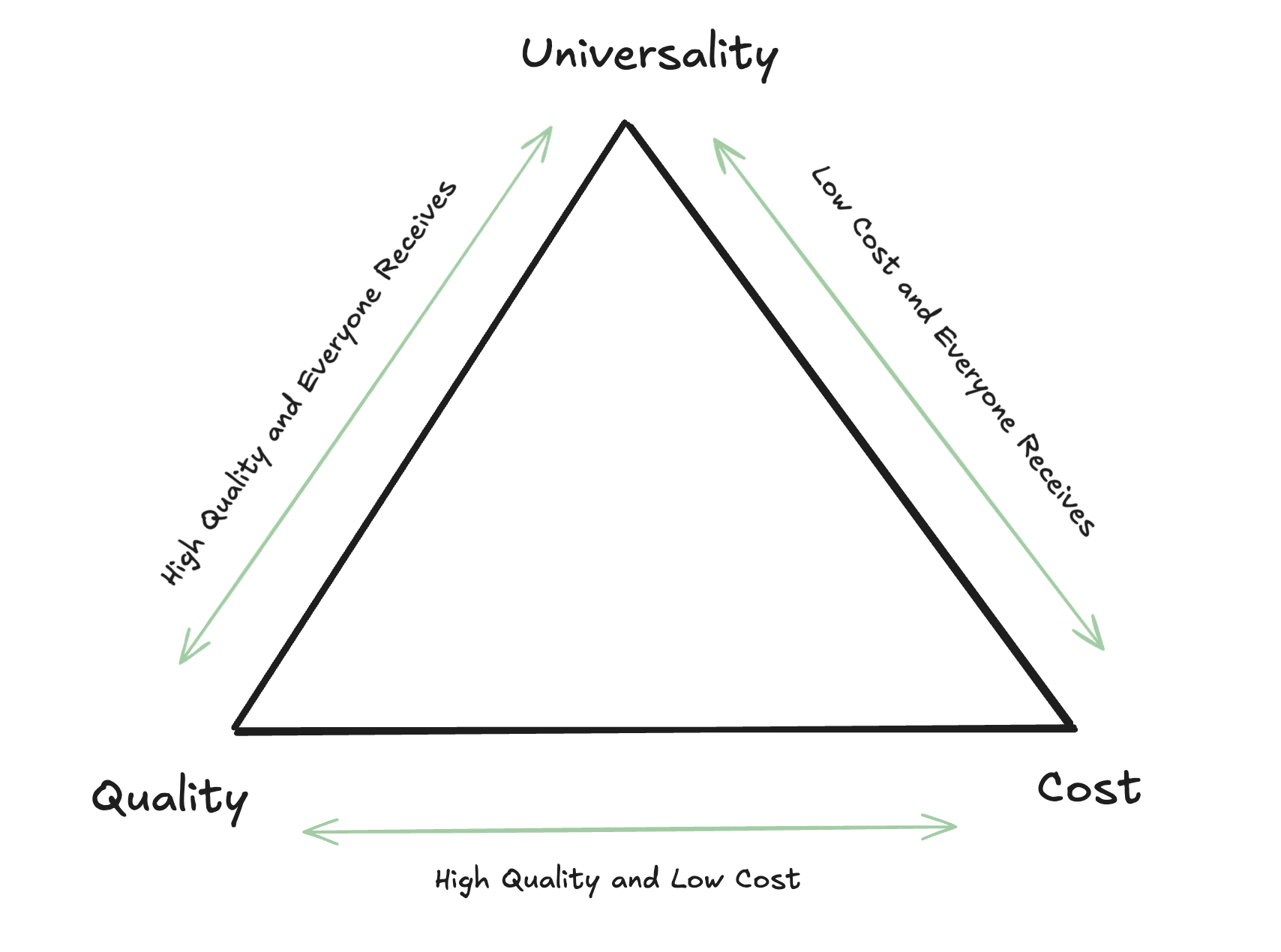
I believe goods and services in an economy suffer from a trilemma similar to those found in other fields, such as distributed systems (CAP Theorem), project management (Iron Triangle), and energy policy (Energy Trilemma). The triangle looks like the following:
Figure 1.1: The Provisioning Trilemma. An architectural mapping of the fundamental tradeoffs in economic provisioning.
Each corner of our shape is defined below:
Cost
The ability to build or service something cheaply or efficiently. It represents the resource optimization leg of the triangle.
Quality
The ability to build or service something to a high degree of quality, ensuring longevity, effectiveness, and precision.
Universality
The ability for the service or good to be universally available for consumption, regardless of geographic or economic barriers.
It is hard to have good conversations about what we desire as people because we don't acknowledge this trilemma and don't accept that we can choose our tradeoffs. We aren't beholden to choosing and applying one pair to everything in an economy. For example, the United Kingdom has made market-based decisions for its tech industry, prioritizing quality and cost, which differs from its healthcare system, prioritizing universality and cost at the expense of quality.
By choosing a pair, we acknowledge a patch is required for the third leg. Let's examine these pairs and their tradeoffs through a philosopher's favorite technology: hammers.
Cost + Quality: A Market-Driven Approach
Optimizing for cost-effectiveness and quality mirrors the market systems we operate within today. Markets efficiently produce high-quality goods at competitive prices, evidenced by the diverse and innovative hammer options. However, a crucial element is sacrificed in our market pursuit: universality. There's no guarantee everyone will receive a hammer, even if it's a functionally essential tool for everyone. Access is determined by purchasing power and market forces, not by inherent need or right.
Note
Patching up the Universality Concern: To address this universality deficit, we can employ different strategies focused on redistribution and market accessibility.
Targeted Subsidies
Directly assisting low-income households with vouchers or subsidies specifically for hammers, such as tool vouchers for construction apprentices.
NGO Recycling
Development and funding of NGOs that promote the recycling of hammers or other necessary tools for distribution to qualifying individuals.
Market Forces
Allowing market forces to continually lower prices to the point where some semblance of universality can be achieved through efficiency.
The above patches are mostly government-driven programs, given they can create regulations and develop the requisite programs to make these hammer dreams a reality. While these patches improve universality, the core principle remains: market-driven systems prioritizing cost and quality will inherently lead to unequal access unless actively and continuously mitigated by government intervention.
Quality + Universality: The Expensive Approach
Optimizing for quality and universality shifts us from pure market reliance, necessitating intervention to bypass market-driven cost constraints. Under this model, we aim to provide the highest possible quality of goods and services, the "best hammer ever invented," and ensure everyone receives one, regardless of their ability to pay or market demand. However, defining the ceiling of "quality" becomes problematic, and consequently, the overall cost can become unsustainable.
Note
Patching up the Cost Gap: Managing the costs associated with this approach requires proactive strategies focused on efficiency and strategic procurement.
Defining Quality
A centralized authority must determine the upper ceiling of 'quality' that aligns with public expectations and fiscal reality.
Strategic Procurement
Streamlining public sector operations and leveraging the government's bulk purchasing power to negotiate favorable prices for materials.
Public R&D
Investment in public research focused on cost-reducing innovations in manufacturing and materials science to make universal provision viable.
Universality + Cost: "Basic Access for Everyone" Approach
Our final optimization prioritizes universal access above all else while tightly controlling costs. This choice leads to producing and distributing the cheapest possible goods and services. The tradeoff is a drop in quality. Everyone gets a hammer, but it's likely to be of low quality, prone to breaking, and requiring frequent replacement.
Note
Patching up the Quality Deficit: Addressing quality shortcomings requires focusing on utility, longevity, and community support systems.
Minimum Standards
Establishing and enforcing minimum quality standards to prevent unusable or unsafe products from being distributed.
Community Repair
Investing in tool libraries and skill-building programs focused on maintenance and extending the lifespan of low-cost tools.
Tiered Systems
Providing a basic tier universally while facilitating a market for higher-quality options for those with specific needs.
What are the tradeoffs we are willing to make?
This trilemma is not a golden truth but a way to frame goods and service provisioning in an economy. I ignore important implementation details such as decentralized vs centralized systems, pricing mechanisms, etc. However, we should have a frame for only discussing the tradeoffs without slowing ourselves down to a halt in useless low-level conversations when we don't understand our high-level aims.